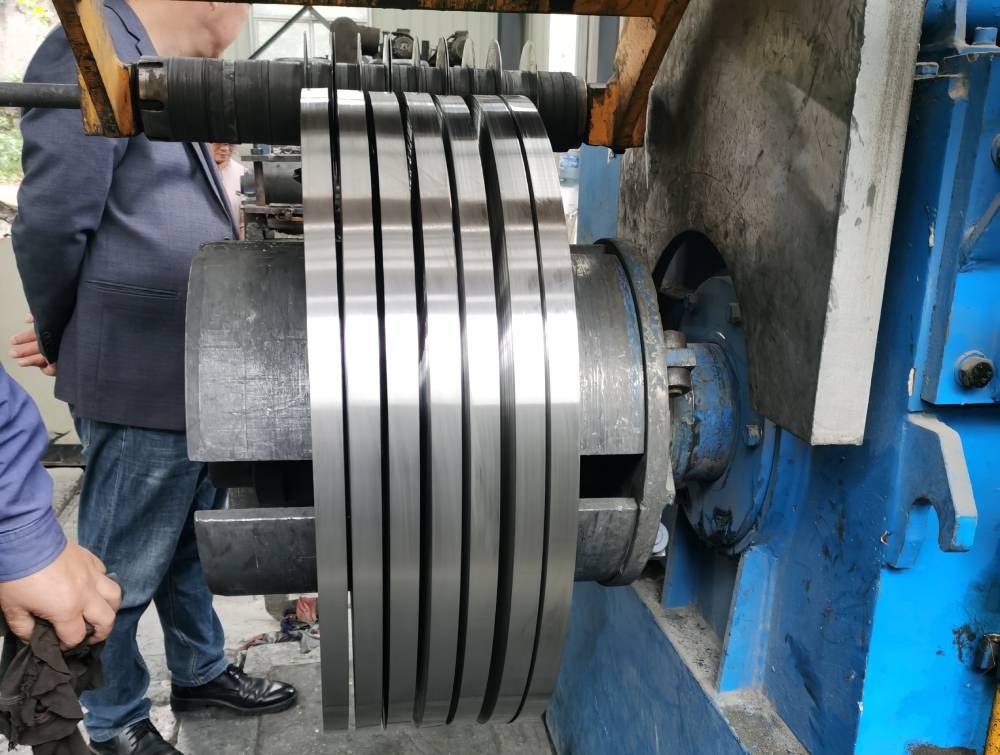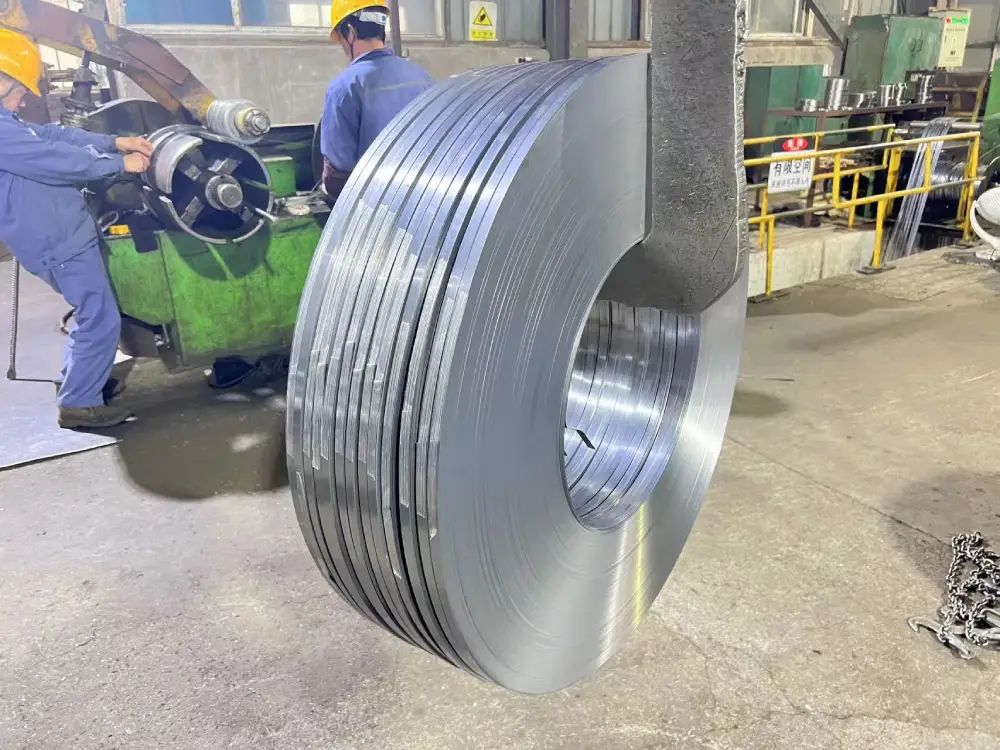

Giới thiệu
The blade industry is evolving rapidly as cutting tools become more specialized, chính xác, and durable. From industrial knives and machine blades to hand tools, razors, and food-processing blades, manufacturers are demanding higher standards from hardened and tempered (H&T) steel strips.
In 2025, the expectations for toughness, hardness stability, edge retention, and material consistency have significantly increased. As a supplier of high-carbon steel strips, Dải thép hợp kim, and stainless-steel strips, understanding these new requirements is essential for meeting global customer needs.
1. Higher and More Stable Hardness Requirements
Modern blades require uniform hardness across the entire strip to ensure consistent cutting performance. Today’s blade manufacturers expect:
- Narrow hardness tolerance (±2–3 HRC)
- High surface hardness for wear resistance
- Stable core toughness to prevent cracking
- Uniform martensitic structure after quenching
Materials such as SK5, 65Mn, C75s, 51CRV4, Và 420 stainless steel must achieve precise hardness levels through optimized quenching and tempering.
Blades used in woodworking, chế biến thực phẩm, textiles, and packaging all benefit from higher hardness without sacrificing elasticity.
2. Improved Flatness and Dimensional Accuracy
For automated cutting, laser slitting, and CNC operations, steel strip geometry is more important than ever. Modern requirements include:
- Flatness tolerance within 0.2–0.5 mm
- Minimal camber and edge wave
- Consistent thickness tolerance (often ±0.005–0.01 mm)
- Precision-cut edges (deburred or rounded)
High flatness directly affects cutting speed, blade lifespan, and machine compatibility.
3. Enhanced Wear Resistance and Edge Retention
Blade users—especially in the industrial sector—require longer working cycles Và less frequent blade replacements. This has increased demand for:
- Finer carbide distribution in alloy steels
- Deep martensitic hardening
- Controlled tempering for better temper resistance
- High-carbon steel grades with micro-alloying
Wear resistance is especially critical for:
- Food-processing blades
- Carpet and textile blades
- Industrial slitter blades
- Wood-cutting blades
Better wear resistance means lower operating costs for end users.
4. Cleaner Steel and Better Surface Quality
With more high-speed automated cutting lines, customers now expect extremely clean and uniform surfaces. Requirements include:
- Minimal oxide scale
- Bright and polished surfaces
- Controlled roughness
- Defect-free edges (no cracks, pits, or scratches)
Cleaner H&T steel strips help reduce blade breakage and improve coating adhesion in high-end blade applications.
5. Increased Demand for Stainless Hardened & Dải thép nóng tính
Corrosion resistance is essential for blades used in:
- Food industry
- Medical equipment
- Marine environments
- Outdoor tools
This drives the rising use of 420, 430, 440A/B/C stainless steel hardened & dải nóng. Customers expect:
- High hardness (48–58 HRC depending on grade)
- Strong anticorrosion properties
- Stable microstructure after quenching
- Smooth surface suitable for polishing or coating
The combination of hardness + corrosion resistance makes stainless H&T strips increasingly important.
6. Tùy chỉnh: Small Batches, Special Hardness, and Flexible Dimensions
Unlike bulk steel industries, blade manufacturers often require custom materials, such as:
- Special hardness levels (VÍ DỤ., products needing 46 HRC or 52 HRC)
- Customized widths (8 mm – 350 mm)
- Ultra-thin sizes (down to 0.10–0.30 mm)
- Pre-sharpened edges or chamfered edges
- Custom coil weights for easy handling
Customization is becoming one of the most important competitive advantages for steel strip suppliers.
7. Better Performance Under High-Speed Cutting
Blades used in automated production lines experience:
- Higher temperatures
- Higher vibration
- Higher cutting pressure
- Longer continuous working hours
Therefore, cứng & tempered steel strips must provide:
- High temper resistance
- Độ đàn hồi ổn định
- Minimal deformation under load
- Good toughness to avoid chipping
Industries like paper cutting, packaging, and film slitting especially rely on high-speed compatible blade steel.
Phần kết luận
The blade industry’s expectations for hardened and tempered steel strips are rising rapidly as advanced manufacturing becomes the global norm. In 2025 và hơn thế nữa, buyers increasingly demand:
- Higher hardness with tighter tolerances
- Better flatness and dimensional accuracy
- Enhanced wear and corrosion resistance
- Cleaner surfaces and defect-free edges
- Stainless H&T steel options
- More customized specifications
- Strong performance under high-speed cutting conditions
For suppliers, these trends represent significant opportunities—especially for manufacturers capable of providing precision heat treatment, superior surface quality, và tùy biến linh hoạt.
Keeping up with these requirements enables blade makers to produce sharper, stronger, and more durable tools that meet the expectations of modern industries worldwide.