1. Introducción
Cold-rolled steel coils are essential materials for industries requiring tight dimensional control, excellent surface finish, and superior mechanical performance.
They serve as the foundation for products such as tiras de acero para resortes, stainless blades, automotive components, and electronic parts.
En MTC de Jiaxiao, we specialize in manufacturing high-carbon, aleación, y tiras de acero inoxidable through advanced cold-rolling processes.
Let’s explore how these coils are made — step by step — and what makes our products stand out in quality and consistency.
2. What Is Cold Rolling?
Cold rolling is a metalworking process in which hot-rolled steel is further reduced in thickness at room temperature using precision rollers.
Unlike hot rolling, which shapes steel while it’s red-hot, cold rolling enhances the dimensional accuracy, llanura, y surface brightness of the final product.
Key benefits include:
- Improved calidad de la superficie y appearance
- Higher límite elástico y dureza
- Precise thickness and width tolerances
- Better formability y elasticidad
3. Step-by-Step Manufacturing Process
Paso 1: Hot-Rolled Coil Pickling
The process begins with hot-rolled coils, which have a rough, oxidized surface after initial rolling.
These coils undergo acid pickling — removing scale and surface impurities using hydrochloric or sulfuric acid — leaving a clean steel surface ready for cold reduction.
Jiaxiao MTC uses continuous pickling lines that ensure a uniform, oxide-free surface, which is essential for consistent cold-rolling performance.
Paso 2: Laminado en frío
The cleaned coil is then processed in 4-high or 6-high cold-rolling mills.
Aquí, the material is compressed between hardened rollers to achieve the desired final thickness — often between 0.1 mm and 3.0 milímetros.
During this step:
- Thickness reduction can reach 50–90%, depending on the grade.
- Rolling pressure and speed are precisely controlled to avoid residual stress or deformation.
- The process increases the steel’s resistencia a la tracción y dureza.
Paso 3: Recocido (Softening Treatment)
Cold rolling increases hardness but reduces ductility, so the material must be recocido to restore its formability.
Annealing involves heating the coil in a controlled atmosphere furnace to around 680–780 °C, then slowly cooling it to produce a uniforme, soft microstructure.
En el Centro Comercial Jiaxiao, bright annealing is performed in protective hydrogen or nitrogen atmospheres, preventing oxidation and giving the surface a bright metallic luster.
Paso 4: Skin-Passing and Levelling
After annealing, the coils undergo skin-pass rolling — a light reduction process that improves flatness and controls surface texture.
This step ensures the coil has:
- Consistent mechanical properties
- Liso, uniform surface roughness
- Excellent dimensional accuracy
Paso 5: Slitting and Edge Treatment
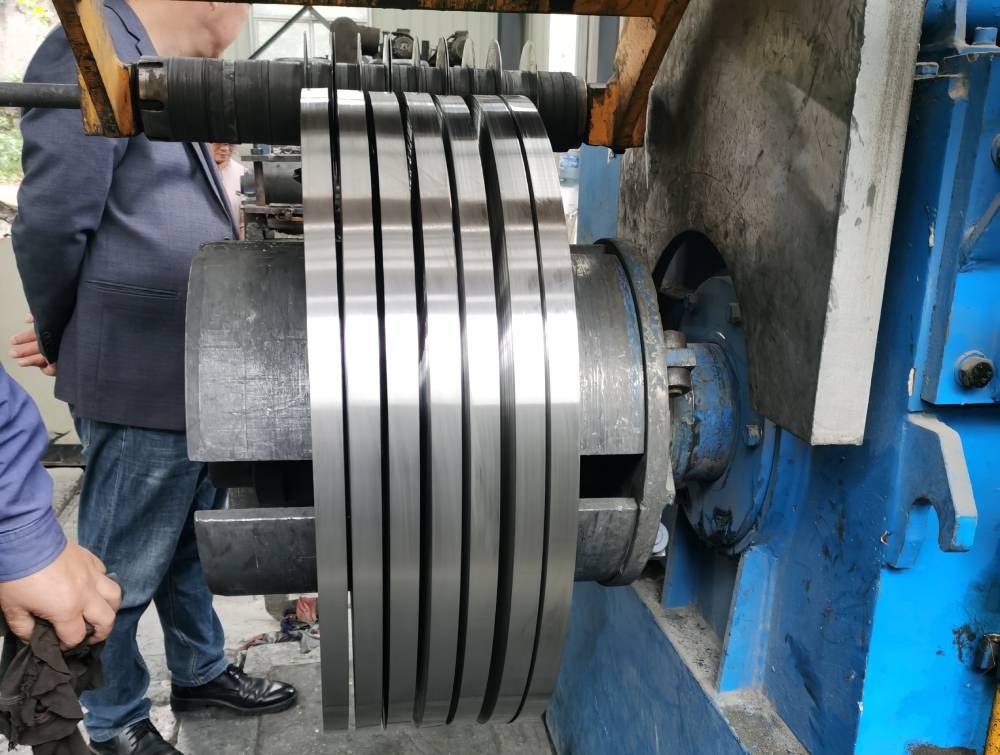
The annealed coils are slit into narrow strips using high-precision slitting machines.
Edges can be customized as:
- borde cortado (mill edge)
- Round edge
- Square edge
Jiaxiao MTC offers precision edge finishing for specific industrial requirements — for example, rounded edges for spring steel or flat edges for blade manufacturing.
Paso 6: Surface Finishing
Depending on customer needs, coils can receive surface treatments such as:
- Bright polished finish
- Matte finish
- Blue or yellow temper color
- Protective oil coating
These finishes enhance appearance, resistencia a la corrosión, and lubricity for downstream forming processes.
Paso 7: Inspection and Packaging
Before shipment, each coil undergoes:
- Hardness and tensile tests
- Thickness and width measurements
- Surface inspection under magnification
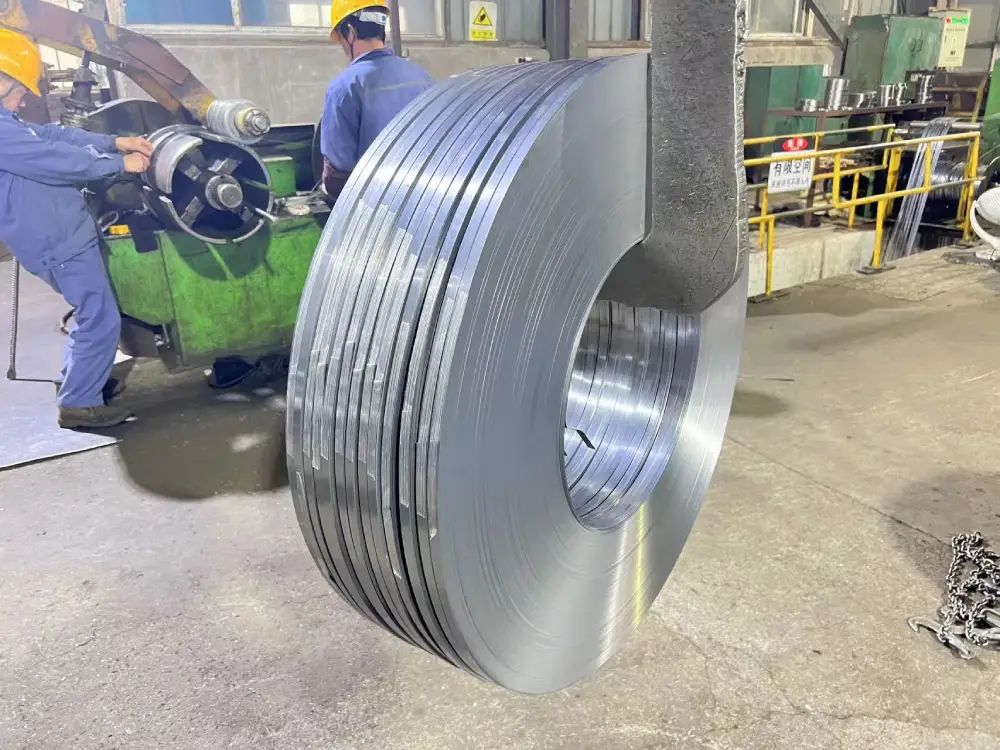
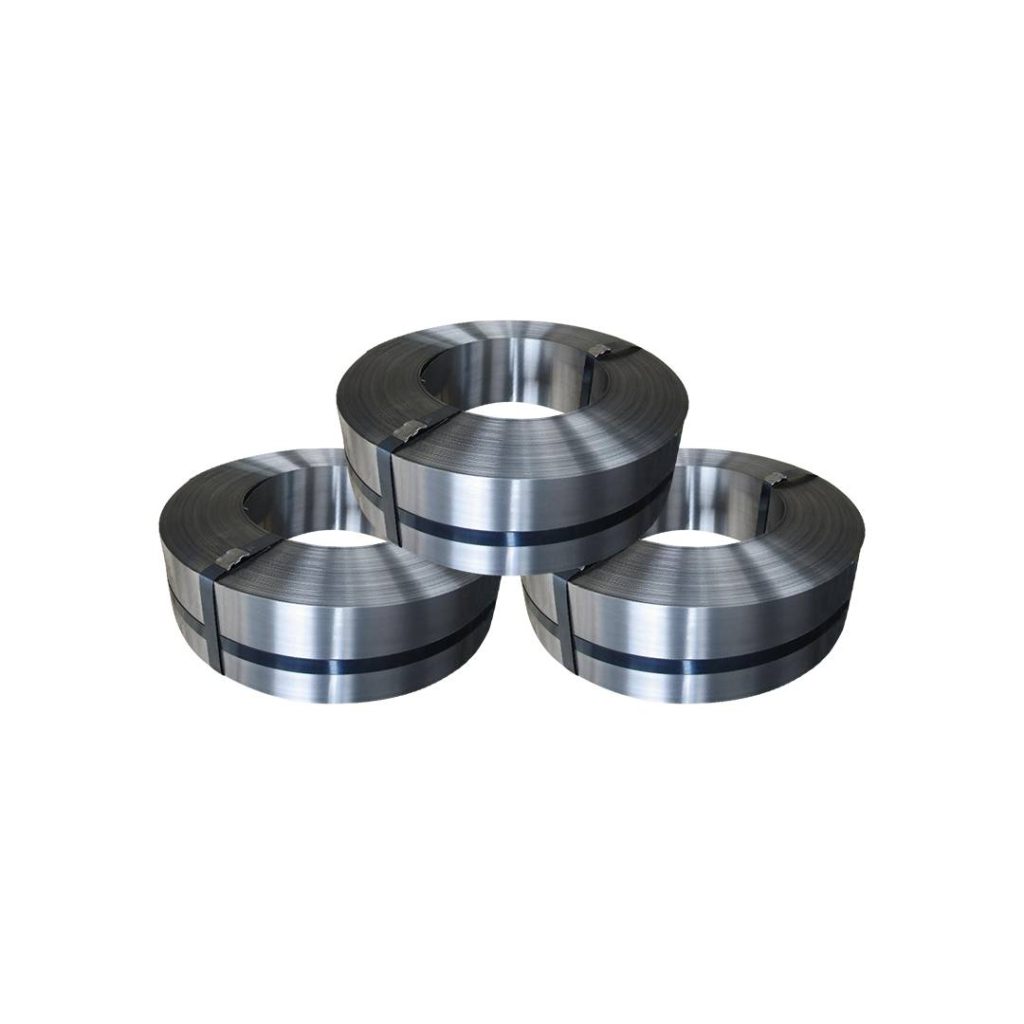
Coils are then wrapped with anti-rust film, plastic layers, and steel bands, ensuring safe export packaging suitable for long-distance marine transport.
4. Jiaxiao MTC’s Cold-Rolling Advantages
| Característica | Benefit |
|---|---|
| Advanced Cold-Rolling Mills | Achieve thickness tolerance ±0.015 mm |
| Bright Annealing Furnaces | Clean, oxidation-free surfaces |
| Full In-House Processing | From pickling to slitting and tempering |
| Flexible Material Range | C75S, 50CrV4, SK5, 301, 420, y más |
| Estricto control de calidad | ISO certified with 100% coil traceability |
| Export-Grade Packaging | Corrosion-resistant and seaworthy |
Through these technologies, Jiaxiao MTC ensures that every cold-rolled coil meets international mechanical, dimensional, and surface quality standards.
5. Applications of Cold-Rolled Steel Coils
Cold-rolled steel coils are widely used in:
- Automotive industry: seat belt parts, discos de embrague, and springs
- Construction tools: paletas, cuchillas, and saw strips
- Hardware manufacturing: shims, lavadoras, shoe shanks
- Precision components: electronic housings, instruments
Whether soft annealed or hardened and tempered, Jiaxiao MTC’s coils provide fortaleza, flexibilidad, and consistency to critical applications worldwide.
6. Conclusión
The cold-rolling process transforms raw hot-rolled steel into high-precision, high-performance coils that power modern industries.
With state-of-the-art rolling mills, annealing furnaces, and quality systems, MTC de Jiaxiao continues to deliver top-grade cold-rolled steel coils for global customers seeking durabilidad, precisión, and reliability.