In the realm of steel manufacturing, high carbon steel strips stand as a vital component, finding extensive applications across diverse industries owing to their distinctive qualities. This article offers an in-depth exploration of both the production process and the characteristics of high carbon steel strips.
я. The Intricate Production Process
А. Selecting Superior Raw Materials
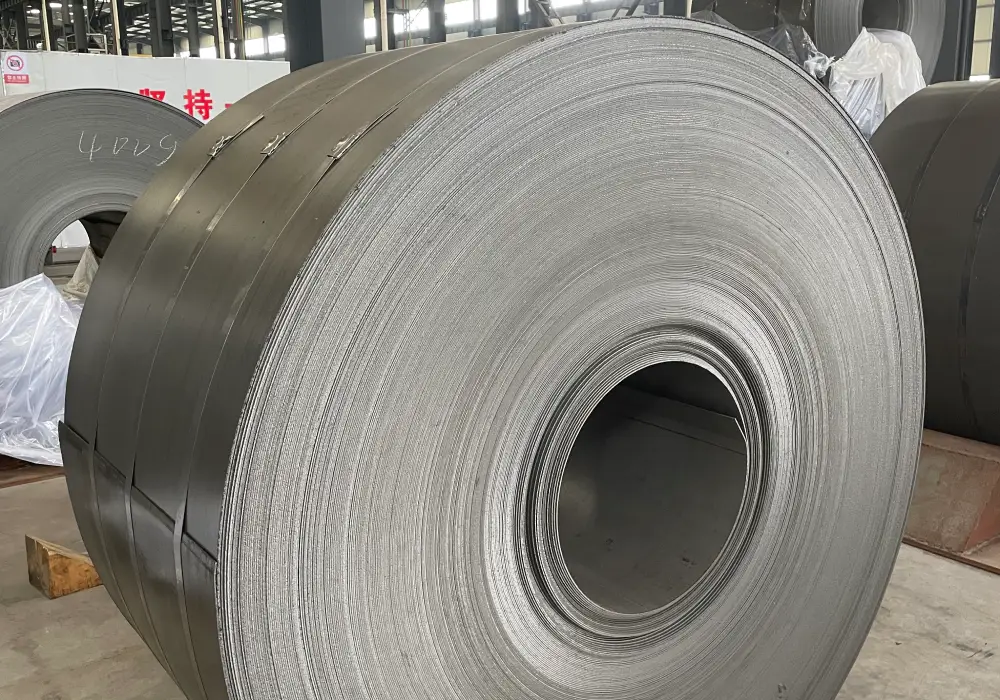
The cornerstone of high-quality high carbon steel strips lies in the careful selection of raw materials. These are typically sourced from ISO-certified state-owned enterprises. In the case of high carbon steel strips, the carbon content is notably high, usually falling within the range of 0.60% к 1.20%, and in some instances, even surpassing this. Besides carbon, elements like manganese, кремний, sulfur, and phosphorus also have to adhere to specific limits to guarantee the final product’s quality.
Б. The Hot Rolling Phase
Hot rolled steel coils, which serve as the starting materials, come with an oxide scale on their surface. This scale, generally 5 – 20um thick and insoluble in water, must be removed. The pickling process is employed for this purpose. Acid is utilized to cleanse and etch the surface, effectively eliminating the oxides and priming the steel for subsequent processing steps.
С. Cold Rolling Operations
Once pickled, the hot rolled steel coils enter the cold rolling stage. Specialized cold rolling facilities are utilized to reduce the coil thickness to the desired level while attaining precise dimension tolerances. Например, 4 high reversing cold rolled mills are commonly used to produce thinner strips with thicknesses ranging from 0.08mm to 0.15mm and optimized tolerances. During cold rolling, the hot rolled steel coil passes between two rollers rotating in opposite directions. The gap between the rollers is meticulously adjusted to be less than the starting coil’s thickness, gradually thinning the steel strip.
Д. The Significance of Annealing
Annealing is a crucial step in the production of high carbon steel strips. There are various types of annealing processes, such as bright annealing and spheroidization. In bright annealing, the steel coil is placed within a confined space of an annealing furnace and heated to a high temperature. Subsequently, a suitable temperature is maintained, and the steel is slowly cooled inside the furnace, resulting in a bright surface free from decarbonization. Spheroidization, on the other hand, is achieved by holding the steel at temperatures near the lower critical point for an extended period or through cyclic heating and cooling close to these temperatures. Prior deformation or hardening can accelerate this process. Spheroidized steel strips are highly suitable for applications demanding maximum cold forming capabilities.
E. Hardening and Tempering Procedures
This thermal process is essential for enhancing the strength of high carbon steel strips. Initially, the steel strip is heated above the critical transformation temperature specific to its grade and then rapidly cooled. At this point, the steel strip becomes extremely brittle and necessitates further treatment. Subsequently, the strips are reheated to a lower temperature and held at this temperature for a specific duration. This process is carried out in an inert atmosphere to prevent oxidation. Through hardening and tempering, high carbon steel strips acquire a high level of toughness and excellent spring properties.
II. Outstanding Characteristics
А. Exceptional Strength
High carbon steel strips exhibit significant strength due to their relatively high carbon content. This property makes them highly suitable for applications where strength is of utmost importance, such as in the manufacturing of springs. Springs need to endure repeated loading and unloading without undergoing deformation, and high carbon steel strips fulfill this requirement effectively.
Б. Superior Wear Resistance
The elevated carbon content also endows high carbon steel strips with good wear resistance. They can maintain their shape and integrity even under frictional and abrasive conditions. This makes them ideal for use in components that are prone to wear, like certain machine parts.
С. Adjustable Hardness
High carbon steel strips can attain a relatively high hardness level. Through appropriate heat treatment processes like hardening and tempering, their hardness can be adjusted within a specific range to meet the particular requirements of different applications. Например, in the production of cutting tools, the right hardness ensures sharpness and durability.
Д. Remarkable Spring Properties
Thanks to the hardening and tempering process, high carbon steel strips display excellent spring properties. They can efficiently store and release energy, which is crucial for applications such as in the manufacturing of various springs, including those used in automotive suspensions and mechanical devices.
В заключение, the production process of high carbon steel strips is a complex and precise sequence of steps that demands strict control at each stage to ensure the quality of the final product. Their unique characteristics render them indispensable in many industries. Continuous research and improvement in production technology will undoubtedly further expand their application fields and enhance their performance.
By grasping the production process and characteristics of high carbon steel strips, manufacturers and users can make more informed decisions when selecting and applying these materials, thereby promoting the development and innovation of related industries.