I. Material Overview & Standardization
C75S is a high-carbon, non-alloy spring steel standardized under the German DIN EN 10132-4 specification. It corresponds to Chinese GB/T 75, American AISI 1075, and Japanese JIS S75CM standards. Its core characteristics are a high elastic limit and excellent fatigue resistance. Under comparable surface conditions and full hardenability, its fatigue limit can match some alloy spring steels. As a typical non-alloy spring steel, C75S achieves a balance of strength and toughness through precise control of carbon content (0.70%-0.80%) and impurity elements (P≤0.025%, S≤0.025%). It is particularly suitable for manufacturing small-to-medium-sized spring components.
II. Chemical Composition & Mechanical Properties
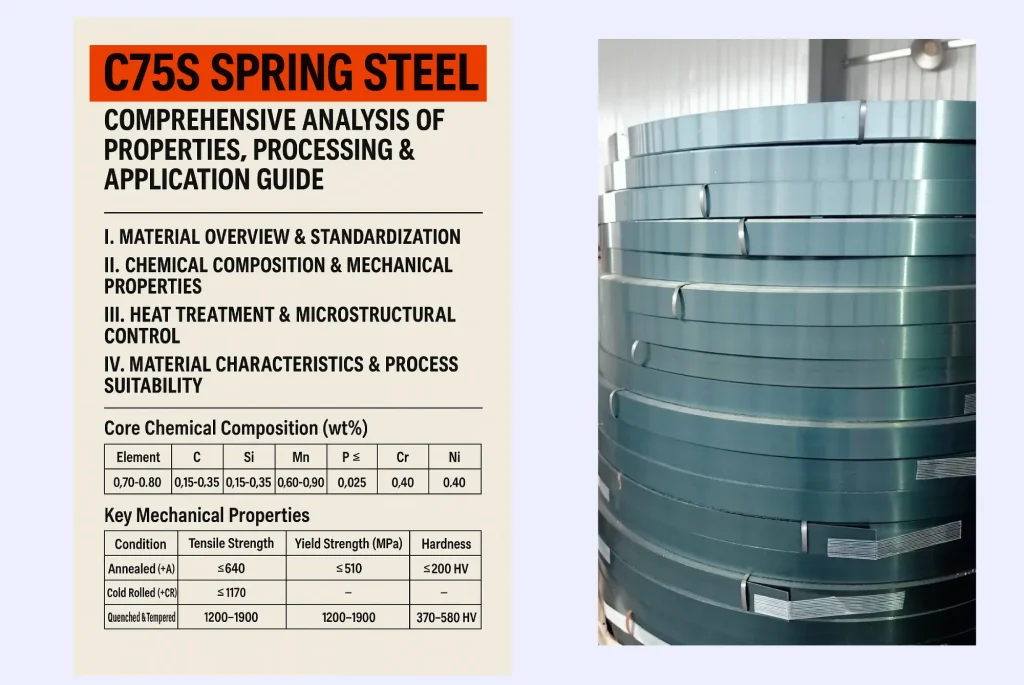
- Core Chemical Composition (wt%)
| Élément | C | Si | Mn | P≤ | S≤ | Cr≤ | Ni≤ | Mo≤ |
|---|---|---|---|---|---|---|---|---|
| Contenu | 0.70-0.80 | 0.15-0.35 | 0.60-0.90 | 0.025 | 0.025 | 0.40 | 0.40 | 0.10 |
Source: DIN EN 10132-4:2000
- Key Mechanical Properties
| Condition | Résistance à la traction (MPa) | Limite d'élasticité (MPa) | Elongation (%) | Hardness |
|---|---|---|---|---|
| Recuit (+A) | ≤640 | ≤510 | ≥15 | ≤200 HV |
| Cold Rolled (+CR) | ≤1170 | – | – | ≤320 HV |
| Quenched & Tempered (+QT) | 1200-1900 | – | – | 370-580 HV |
Note: Quenched & Tempered hardness corresponds to HRC 38-55, depending on tempering temperature.
III. Traitement thermique & Microstructural Control
- Typical Heat Treatment Sequence
- Recuit: 680-710°C, furnace cooled. Relieves machining stress, produces pearlite + ferrite structure, hardness ≤200 HV, facilitating cold working.
- Quenching: 780-820°C, oil or water quenched. Austenitization followed by rapid cooling forms martensite, achieving hardness of 60-64 HRC. (Oil quenching reduces distortion/cracking risk; water quenching suitable for thin sections).
- Tempering: 180-300°C, hold 1-3 hours. Adjusts hardness to 38-55 HRC, relieves internal stresses, forms tempered troostite structure, enhancing elastic stability.
- Process Innovation Case Study
- C75S strip for retaining rings achieved ≥Grade 7 grain size and decarburization layer ≤0.06mm via clean steelmaking (LF + RH refining, inclusion rating ≤4.0) and controlled rolling/cooling (finishing temperature ≤900°C, coiling temperature ≤650°C). After quenching and tempering, hardness reached 53-58 HRC, meeting high-end requirements for fatigue life (1 million cycles without cracking).
IV. Material Characteristics & Process Suitability
- Avantages principaux
- Cost-Effectiveness: Lacks expensive alloying elements.
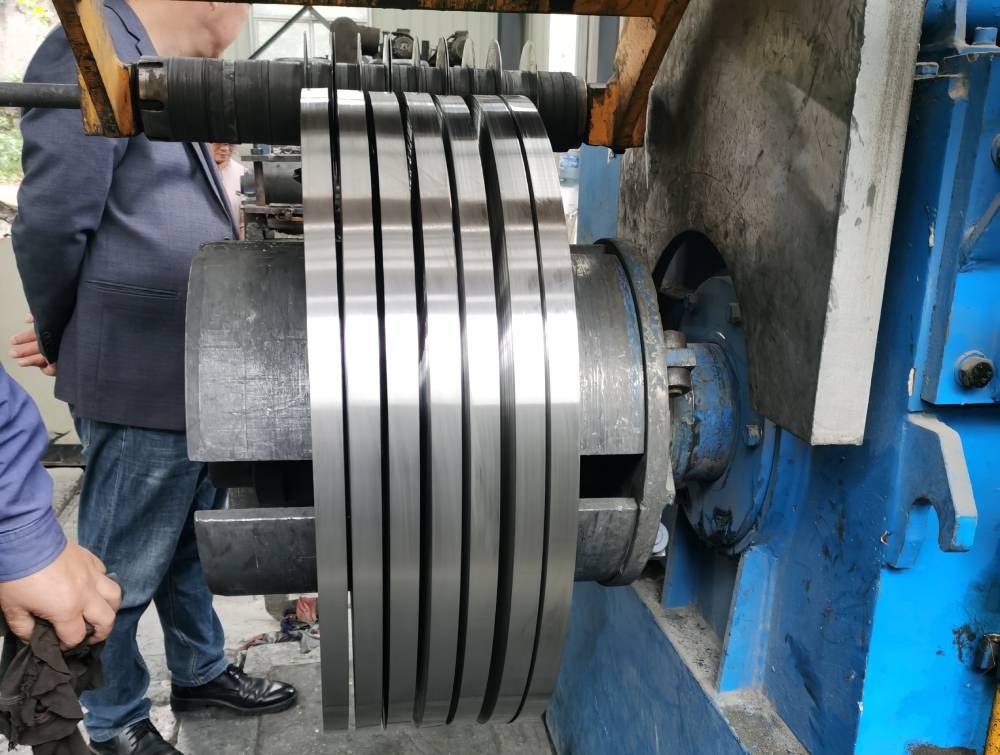
- Machinability: Annealed state allows stamping and bending. Cold-rolled strip achieves tight thickness tolerances (±0.008mm), ideal for precision parts.
- Surface Quality: Cold-rolled surface roughness Ra≤0.8μm, often eliminating the need for additional polishing for spring applications.
- Limitations
- Limited Hardenability: Oil quenching effective diameter ≤12mm. Large sections require water-oil quenching.
- Poor Weldability: Preheating ≥300°C required before welding; post-weld stress relief annealing at 600°C necessary.
V. Application Areas & Case Studies
- Key Application Fields
| Sector | Typical Products | Key Performance Requirements |
|---|---|---|
| Automotive | Clutch diaphragm springs, brake springs | Tensile strength ≥1400MPa, Fatigue limit ≥600MPa |
| Precision Machinery | Watch mainsprings, instrument hairsprings | Elastic modulus 210GPa, Permanent set ≤0.1% |
| Tool Manufacturing | Hand saw blades, cutting blades | Hardness 52-55 HRC, Excellent edge wear resistance |
| Appliances | Washing machine damper springs, printer pressure springs | Stress relaxation rate ≤5% (150°C × 1000h) |
- Innovative Application Case
- In new energy vehicle battery packs, laser-welded C75S strip, tempered at low temperature, forms battery compression springs. Precise hardness control (42-45 HRC) and flatness (≤0.15mm) ensure uniform pressure (200-300N) on battery cells while maintaining stability across temperature cycles (-40°C to 125°C).
VI. Performance Comparison with Competing Materials
| Propriété | C75S (DEPUIS 1.1248) | 65Mn (GB/T 1222) | 55SiCr (EN 10089) |
|---|---|---|---|
| Carbon Content | 0.70-0.80% | 0.62-0.70% | 0.51-0.59% |
| Limite d'élasticité (QT) | 1200-1600 MPa | 1100-1500 MPa | 1300-1700 MPa |
| Fatigue Limit | 550-650 MPa | 500-600 MPa | 650-750 MPa |
| Hardenable Dia. (Oil) | ≤12 mm | ≤20 mm | ≤30 mm |
Conclusion: C75S offers outstanding cost-performance for small-to-medium springs, matching 65Mn performance while offering significant cost advantages over 55SiCr.
VII. Sélection & Application Guidance
- Specification Guide
- Cold-Rolled Strip: Thickness 0.15-2.0mm. Ideal for precision springs, blades.
- Hot-Rolled Plate: Thickness 2.0-20mm. Used for large dies, mechanical parts.
- Cold-Drawn Wire: Diameter 1.0-10.0mm. For coil springs, clock springs.
- Quality Control Essentials
- Decarburization Check: Critical springs require total decarb depth ≤1% of thickness (e.g., ≤0.005mm for 0.5mm strip).
- Non-Metallic Inclusions: Use ultrasonic inspection (≥Grade 2 per GB/T 10561) to avoid premature failure from Type B inclusions.
- Hardness Uniformity: Batch hardness variation should be ≤3 HRC.
VIII. Industry Trends & Technological Outlook
- Microalloying Enhancement: Adding 0.02-0.05% Nb refines grain structure, potentially increasing tensile strength by 8-12%, enabling use in larger springs.
- Green Manufacturing: Direct rolling of continuous cast slabs (CC-HDR) reduces energy consumption by 15% and CO₂ emissions by 20%.
- Surface Coating Technology: PVD Cr coating or nitriding increases surface hardness to >800 HV, improving wear resistance by 30%, suitable for corrosive environments.
Conclusion
C75S spring steel maintains an indispensable position in small-to-medium springs and precision cutting tools due to its balanced properties, controlled cost, and broad process adaptability. Driven by automotive lightweighting and smart manufacturing, material-process-design integration will likely unlock new applications in emerging fields like new energy and robotics. Engineers are advised to prioritize cold-rolled thin-gauge products to leverage their high precision and surface quality, while emphasizing supplier clean steelmaking capabilities to ensure consistent material performance.