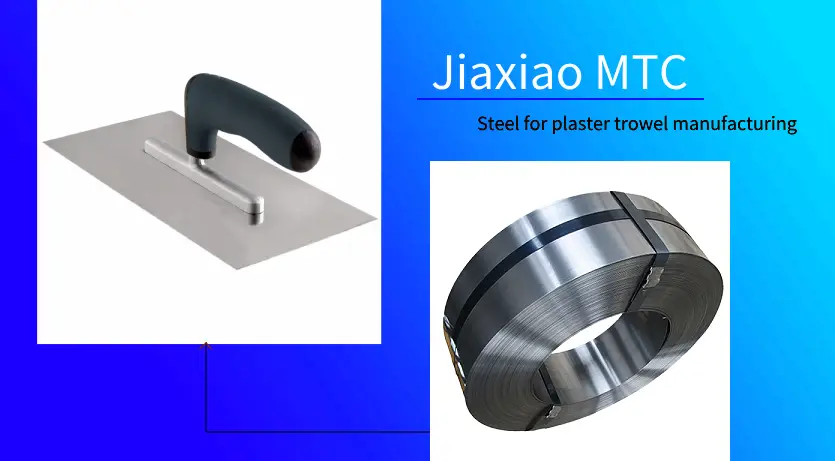
In the realm of architecture and decoration, the plaster trowel is an indispensable tool, and its quality and performance directly impact the efficiency and outcome of construction. One of the crucial factors determining the quality of a plaster trowel is the type of steel selected during the manufacturing process. Different types of steel endow the plaster trowel with distinct characteristics, enabling it to meet the requirements of various complex construction environments. Today, we will delve deeply into the various types of steel employed in the production of plaster trowels and assist manufacturers in making judicious choices.
I. Tool Steel: The Robust Option for Plaster Trowels
Tool steel, renowned for its exceptional hardness and wear resistance, is one of the commonly used materials in the manufacturing of plaster trowels. Through a special heat treatment process, this type of steel can achieve a relatively high level of hardness, making it less prone to wear and deformation when in contact with diverse building materials.
For instance, D2 tool steel is a high-carbon and high-chromium tool steel with outstanding wear resistance and cutting performance. In the application of plaster trowels, it can effortlessly handle the friction of materials such as cement and mortar, maintaining the sharpness and shape stability of the blade. Simultaneously, D2 tool steel also possesses good toughness and can endure a certain degree of impact and pressure without breaking easily. This ensures that the plaster trowel made of D2 tool steel remains reliable in harsh construction environments.
Another prevalent tool steel is S7 tool steel. It is a tool steel with excellent impact toughness, particularly suitable for manufacturing tools that need to withstand substantial impact loads. In the usage of plaster trowels, there may be unexpected impacts or pressures. The high toughness of S7 tool steel guarantees that the plaster trowel will not be easily damaged under such circumstances and prolongs its service life.
For the selection of tool steel, manufacturers need to take into account multiple factors. Firstly, it is the balance between hardness and toughness. Although high hardness can enhance the wear resistance of the plaster trowel, excessive hardness may render the steel brittle and reduce its toughness. Therefore, manufacturers must choose tool steel with appropriate hardness and toughness based on specific usage scenarios and requirements. Secondly, it is the processing performance of tool steel. Good processing performance can ensure that manufacturers can smoothly process the steel into plaster trowels of various shapes and sizes, thereby improving production efficiency.
II. Spring Steel: Conferring Flexible Elasticity to Plaster Trowels
Spring steel, as the name suggests, is known for its excellent elasticity and resilience. In the production of plaster trowels, the application of spring steel can bring numerous conveniences to construction.
The elastic properties of spring steel enable the plaster trowel to better conform to the wall or ground during use, resulting in a more uniform and flat application of mortar. For example, when applying to curved or irregular surfaces, the spring steel plaster trowel can flexibly deform according to the surface shape to ensure the even coverage of mortar and enhance the construction quality.
5160 spring steel is a commonly used spring steel material with good comprehensive performance. It not only has a high elastic limit and fatigue strength but also exhibits a certain degree of hardness and wear resistance. This allows the plaster trowel made of 5160 spring steel to maintain stable elastic performance during long-term use and simultaneously possess sufficient strength and wear resistance, making it less likely to be damaged.
9260 spring steel is also a favored choice. It has higher strength and hardness while maintaining good elasticity and toughness. The plaster trowel made of 9260 spring steel can withstand greater pressure and load, making it suitable for some construction scenarios with higher performance requirements for plaster trowels.
When choosing spring steel, manufacturers should focus on its elastic performance and fatigue strength. Elastic performance directly affects the usage effect of the plaster trowel, and fatigue strength determines the reliability and service life of the plaster trowel during long-term repetitive use. Additionally, the heat treatment process of spring steel also has a significant impact on its performance. Manufacturers need to ensure the adoption of appropriate heat treatment processes to fully leverage the advantages of spring steel.
III. Stainless Steel: The Combination of Corrosion Resistance and Aesthetic Appeal
In certain special construction environments, such as damp, salty, or chemically corrosive places, stainless steel becomes an ideal choice for manufacturing plaster trowels. Stainless steel possesses excellent corrosion resistance and can effectively resist the erosion of various corrosive media, maintaining the appearance and performance of the plaster trowel.
304 stainless steel is the most common stainless-steel material and is widely used in various fields. It has good corrosion resistance, processing performance, and welding performance. In the production of plaster trowels,304stainless steel can ensure that the plaster trowel is not easily rusted in a damp environment and is also easy to process and manufacture, which can meet the needs of different shapes and sizes.
420 stainless steel is a martensitic stainless steel with relatively high hardness and strength. Although its corrosion resistance is slightly inferior to that of 304 stainless steels, on some occasions where higher hardness is required, 420 stainless steel remains a viable option. For example, when scraping and trimming harder materials, the 420 stainless steel plaster trowels can perform better.
However, it should be noted that the hardness of stainless steel is generally relatively low, which means that it may not be as wear-resistant as tool steel or spring steel. Therefore, when choosing stainless steel to manufacture plaster trowels, manufacturers need to carefully weigh the specific usage environment and requirements. If the main challenge in the construction environment is corrosion and the requirement for wear resistance is not high, then stainless steel is a suitable choice. But if the plaster trowel needs to be used in a high-wear environment, other more wear-resistant steels may need to be considered, or special surface treatment can be performed on the stainless steel to improve its wear resistance.
IV. Comprehensive Consideration Factors for Selecting the Appropriate Steel
When choosing steel for plaster trowels, manufacturers need to comprehensively consider multiple factors to ensure that the selected steel can meet the performance requirements and market demands of the product.
Firstly, it is the usage scenario and purpose of the plaster trowel. Different construction environments and tasks have different performance requirements for plaster trowels. For example, in ordinary indoor plastering work, the requirements for the wear resistance and hardness of the plaster trowel may be relatively low, while the requirements for its elasticity and operability are relatively high. In this case, spring steel or some tool steels with moderate hardness may be a more appropriate choice. In some large-scale construction projects or industrial fields, the plaster trowel may need to frequently come into contact with high-strength building materials and withstand greater pressure and wear. At this time, tool steel with higher hardness and better wear resistance is necessary.
Secondly, it is the cost factor. Different types of steel have significant price differences, which will directly affect the production cost and market price of plaster trowels. Manufacturers need to reasonably control costs and select the steel with the highest cost-effectiveness under the premise of ensuring product quality and performance. Generally speaking, the prices of tool steel and spring steel are relatively high, while the prices of stainless steel vary depending on grades and specifications. Manufacturers can choose steel within an appropriate price range according to market positioning and target customer groups.
In addition, the supply stability of steel is also a factor that needs to be considered. When mass-producing plaster trowels, it is essential to ensure a stable supply of the required steel. If the supply of a certain steel is unstable, it may lead to production interruptions and affect the normal operation of the enterprise. Therefore, when choosing steel, manufacturers are advised to establish long-term cooperative relationships with reliable suppliers to ensure the stable supply of steel.
V. Summary and Outlook
In conclusion, there are numerous types of steel used in the manufacture of plaster trowels, and each type of steel has its own unique advantages and application scenarios. The hardness and wear resistance of tool steel make it suitable for high-wear environments; the elasticity of spring steel endows the plaster trowel with better operating performance and adaptability; the corrosion resistance of stainless steel enables it to perform well in special environments.
When choosing steel, manufacturers should fully consider factors such as the usage scenario, cost, and supply stability of the plaster trowel, carefully weigh the pros and cons of various steels, and select the most suitable material for their products. At the same time, with the continuous advancement of technology and the ever-changing market demands, new types of steel and material treatment technologies are constantly emerging. Manufacturers should closely follow industry trends, actively explore and apply new materials and technologies, and continuously improve the quality and performance of plaster trowels to meet the increasingly diverse needs of the market.
I hope that through the introduction of this article, it can help plaster trowel manufacturers gain a deeper understanding of the various types of steel used in the manufacture of plaster trowels and provide useful references for them when choosing suitable materials. In the future of construction, I believe that with the continuous innovation and development of material technology, plaster trowels will become more durable, efficient, and multifunctional, making greater contributions to the progress of the construction industry.
Do you have any unique insights or experiences in choosing steel for plaster trowel manufacturing? Welcome to share your thoughts in the comment area and let us engage in communication and learning together.